Agricultural Education Day: A Time for Honest Reflection and Urgent Reorientation

Every 3rd December, Agricultural Education Day is observed under ICAR to honour Dr. Rajendra Prasad.But this day must be more than a symbolic tribute.It must be a moment for the entire agricultural education system — universities, research institutions, extension networks, and all professionals — to pause, reflect, and recalibrate.
Because the truth is simple:Farmers and farming have changed dramatically over the last 75 years.Agricultural education, research, and extension have not.

The Disconnect We Can No Longer Ignore
India’s farmers have moved through waves of transformation — from food shortages to surpluses, from rainfed subsistence to commercial crops, from manual labour to mechanisation, from traditional markets to global uncertainty.Digital technology, climate variability, rural migration, global value chains, and consumer-driven agriculture are reshaping the landscape every single day.
Yet much of our agricultural education system still resembles what it was four or five decades ago:
outdated syllabuses,
obsolete pedagogies,
minimal integration of digital agriculture,
limited focus on value addition and entrepreneurship,
excessive obsession with varietal development,
and an extension system still operating on assumptions from the 1960s.
This widening gap cannot be ignored any longer.
Education: Expanding the Responsibility of Graduates
Agricultural graduates today branch into diverse careers — private companies, banks, management schools, start-ups, NGOs, the corporate sector.
That is normal.But what is often forgotten is this:
Every agricultural graduate is groomed using public money — farmers’ money.They carry a lifelong responsibility to farming and the farming community.
This responsibility:
does not end when they take a corporate job,
does not pause when they change sectors,
and certainly does not disappear after retirement.
Agricultural education is not merely a pathway to personal career growth.It is a social contract — a commitment to contribute, in some form, to farmers and agriculture, regardless of where one works.
Teaching & Curriculum: Time to Break the Comfort of Old Notes
Many teachers still rely on:
decades-old lecture notes,
outdated textbooks,
syllabuses built for a vanished agricultural landscape.
This is not just inadequate — it is unfair to students and harmful to the sector.
Agricultural education needs a complete overhaul of:
1. Content
Subjects must reflect modern realities — digital agriculture, climate resilience, agribusiness, IP rights, global markets, food systems, AI and data-driven farming, behavioural science, and value chain management.
2. Pedagogy
The “chalk and talk” comfort zone must give way to:
experiential learning,
interdisciplinary modules,
problem-solving,
field immersion,
design thinking,
and farmer-led knowledge systems.

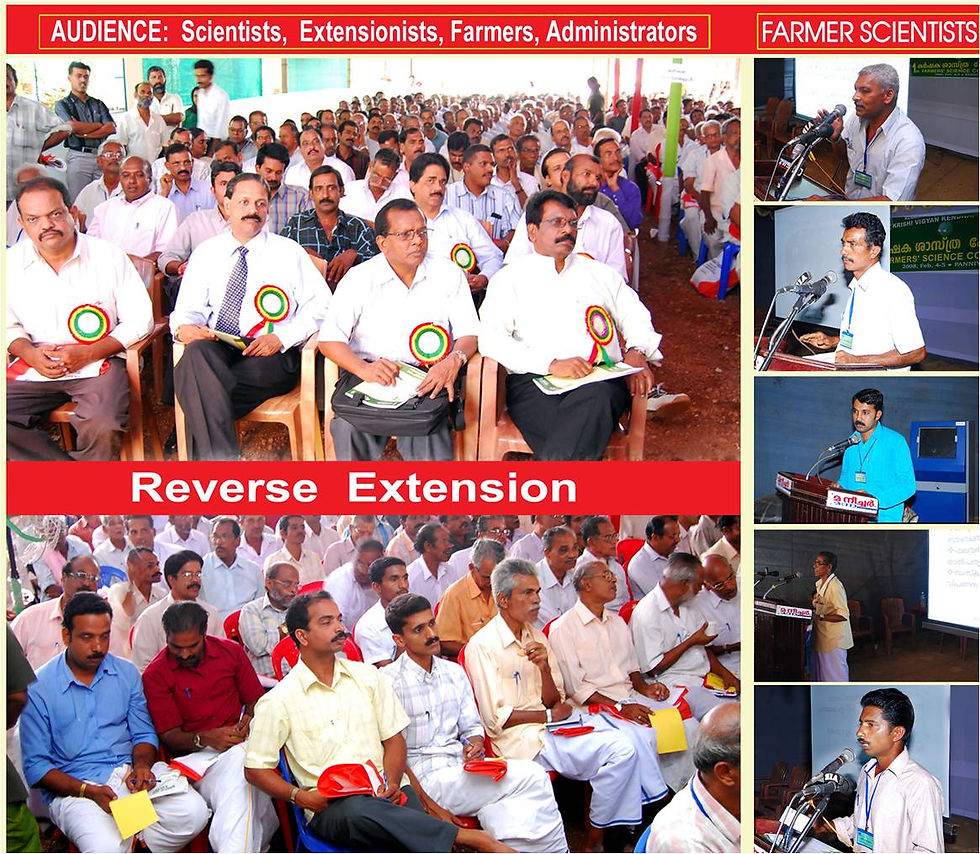
Farmer to Farmer Learning
3. Extension Education
Extension cannot remain a “service activity.”It must become a science with predictable outcomes, grounded in:
Extension Psychology,
Extension Sociology,
Extension Communication,
Behavioural Economics,
Rural Systems Analysis,
Creative and digital extension techniques.
And most importantly, the stale stereotypes that labelled farmers as “laggards,” “fatalistic,” or “unscientific” must be abandoned once and for all.
Professionals must learn to unlearn.
Research: Moving Beyond Varietal Obsession
For decades, agricultural research has focused heavily on developing varieties.While varietal development is important, it cannot remain the dominant focus.
Today’s needs demand:
technologies for value addition,
farmer- and women-friendly tools and equipment,
low-cost micro and macro machinery,
digital and AI-based decision systems,
climate-smart innovations,
soil-less and protected cultivation systems,
processing and branding technologies,
and scalable models of farm-based entrepreneurship.
Farmers need solutions, not just seeds
.


Extension: Returning to Its Roots
The purpose of extension is not demonstration events or target completion.It is to empower farmers through:
scientific advisories that matter,
technologies that work,
communication that respects dignity,
and partnerships that last.
Extension professionals must stop assuming their responsibility ends with retirement.Experience is a national asset — and must continue to serve farmers.
A Reminder About Public Money and Public Purpose
India invests heavily — through taxpayers and farmers — in:
agricultural universities,
research systems,
extension networks,
infrastructure,
scholarships,
laboratories,
and thousands of professionals.
This system exists for farmers, not for the comfort, prestige, or career advancement of those within it.
Agricultural professionals must step out of their comfort niches and ask:“How am I serving the people who fund this system?”
A Call for Renewal
Agricultural Education Day should not be reduced to ceremonial messages.It must become a call for renewal — a demand that:
education evolves,
research becomes relevant,
extension becomes scientific,
and professionals remember their larger purpose.
The future of Indian agriculture depends not only on farmers’ hard work but on the honesty, commitment, and rethinking capacity of the agricultural system that claims to serve them.
Let this day remind us that the real measure of agricultural education is not degrees, publications, or promotions —but the wellbeing, dignity, and progress of the farmers of India.


Comments