First Farmers Science Congress, a pioneering initiative conceptualized by Prof. K. Abdul Kareem

Features
Event Name | First Farmers Science Congress (locally known as Karshaka Sasthra Congress) | |
Dates | February 4 – 5, 2008 | |
Venue | Farm Science Centre/ Krishi Vigyan Kendra (KVK), Kannur (located at Panniyur/Kanjirangad) | |
Visionary / Brain Child | Prof. K. Abdul Kareem PhD (then Professor and Head, KVK Kannur) | |
Primary Organizer | KVK Kannur (under Kerala Agricultural University) Focal Theme "Promoting Farmer Innovations/ Inventions/ Research" | |
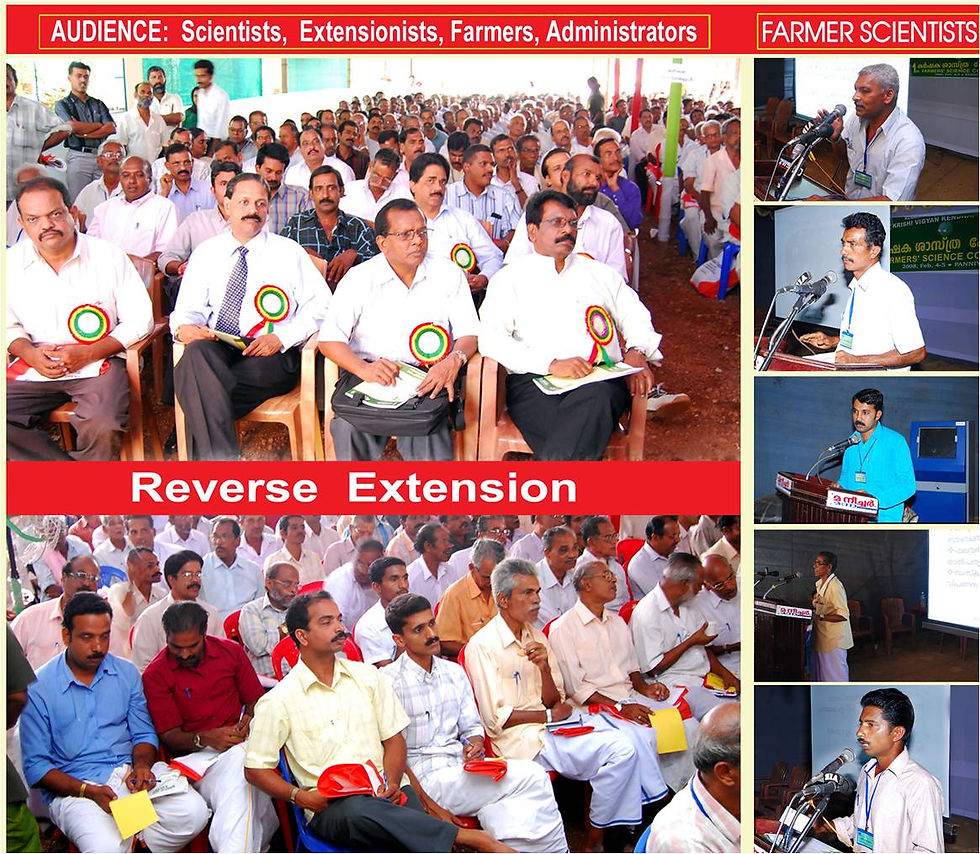
Context & The "Brain Child" Concept | Prof. K. Abdul Kareem conceptualized this event to shift the traditional scientific paradigm. While a standard "Science Congress" typically features scientists presenting papers to other scientists, this event was designed as a reverse platform: |

The Shift: It provided a stage where farmers were the experts and scientists were the audience.
The Goal: To recognize farmers not just as beneficiaries of technology, but as inventors and innovators who develop practical solutions for local agricultural problems. Philosophy: It was rooted in the concept of "Creative Extension," a methodology championed by Prof. Kareem to make agricultural extension more interactive and respectful of indigenous knowledge.
Key Highlights & Activities
Farmer Innovations: The core of the congress was the presentation of papers and innovations by farmers. Many notable examples were presented at the congress.
Audience Response

Proceedings: For the first time, a formal "Proceedings of the Farmers Science Congress" was published, documenting the inventions and findings of the farming community with the same academic rigor usually reserved for professional scientists.

Invitation of Papers
Papers were invited from farmer scientists and categorised under diverse disciplines such as
Agricultural engineering
Agronomy
Pest and Disease Management
Fisheries / animal husbandry
Agro-processing / value addition technology
Genetics / plant breeding and General
Economics/Social Sciences
As a first step farmers were requested to submit the papers containing details about their findings and inventions. Wider publicity were given through print and electronic media.
Publication of Proceedings
The accepted papers were printed and published in the form of a proceedings. as follows. The papers were categorised
Those which can be patented / registered with National innovation foundation
Those which are to be validated
Those which can be transferred to extension system for communicated to farmers
Those which can be taken up as a vocation for rural youths and promoted by Extension / Financial agencies


Exhibition: A large-scale exhibition showcased farmer-developed machinery, unique crop varieties, and value-added products. Impact & Legacy This specific event in February 2008 is widely regarded as a trailblazing effort in the history of agricultural extension in Kerala and India. National Recognition: The success of this congress and related initiatives (like the Compact Area Group Approach or CAGA) was a major factor in KVK Kannur winning the National Best KVK Award for the year 2009, making it the youngest KVK to win the award at that time. Precursor to National Events: While the Indian Science Congress officially held its first "Farmers Science Congress" much later (in 2020), Prof. Kareem’s 2008 event in Kannur serves as an early, predecessor that successfully demonstrated the value of such a platform in the country.
Dar. M. Joseph (also known as M.J. Joseph or affectionately as "Appachan") was a legendary farmer-innovator from Kannur, Kerala. He is best known for inventing a revolutionary coconut tree climbing device that addressed a critical labor shortage in the agricultural sector.
The title "Dar" is unique to him in this context; it stands for "Distinguished Agricultural Inventor" (or Distinguished Agricultural Researcher in some citations), a specific honor conferred upon him during the Farmers Science Congress to recognize his genius despite his lack of formal education. Here are the details of his inventions and legacy: 1. The Coconut Tree Climber (Primary Invention) This is his most famous and impactful invention, born out of the necessity to find a solution for the shortage of professional tree climbers (Thandans) in Kerala. Mechanism: The device consists of two metal loops (one for each leg) with footrests and handles. The user loops them around the tree trunk and uses a pedal-like motion—lifting the left loop while standing on the right, and vice versa—to "walk" up the tree. Impact: It allowed anyone (including non-professionals and women) to climb tall coconut or areca nut trees safely and quickly (in about 2 minutes). Commercial Success: The device was patented and achieved international success, with units being sold to countries like the USA, Mexico, Thailand, Australia, and Brazil. Recognition: It won an award from the National Innovation Foundation (NIF), which helped popularize it globally. 2. Other Innovations While the climber was his masterpiece, Appachan was a prolific tinkerer who observed everyday problems to find solutions. Universal Juice Squeezer: Before the climber, he invented a device capable of squeezing milk from coconuts and juice from various fruits. Although technically successful, it did not gain mass popularity at the time due to its high manufacturing cost. General Approach: He was known for "learning from his surroundings." Despite dropping out of school in the 4th standard, he possessed an innate engineering sense, often developing tools to reduce the drudgery of farm work. Legacy & The "Dar" Title The Title: The honor "Dar" was bestowed upon him at the Farmers Science Congress held at KVK Kannur. It was a deliberate move by the organizers (led by Prof. Kareem) to give a farmer-inventor a title equivalent to "Dr." (Doctor) for scientists.
The Museum: To honor his memory, KVK Kannur established the "Dar. M.J. Joseph Farmers’ Science Museum" at its Panniyur campus. This museum is unique because it is dedicated entirely to showcasing innovations by farmers, preserving the prototypes of Appachan and many others. Final Years: He passed away at the age of 92, just a few months after receiving the "Dar" title, but he lived to see his invention acclaimed globally.
Finance & Support
The First Farmers’ Science Congress was conducted without any financial burden on the Kerala Agricultural University.
The entire event was made possible through the generous support of well-wishers, most notably:
Syndicate Bank
NABARD
The organisers express their deep and enduring gratitude to:
Sri. C. K. Thulaseedharan, then Lead District Manager (LDM), Syndicate Bank, Kannur
Sri. Premkumar, then Assistant General Manager (AGM), NABARD, Kannur
Their ineffable support, unwavering encouragement, and wholehearted belief in farmer-led innovation were instrumental in making the 2008 Congress a reality.
The National Farm Innovators Meet 2010
The National Farm Innovators Meet 2010 The National Farm Innovators Meet 2010 was essentially a national-level scaling of the concept pioneered by Prof. K. Abdul Kareem in Kannur.
Following the success of the 2008 Congress in Kannur, the Indian Council of Agricultural Research (ICAR) recognized the immense value in documenting farmer-led innovations and organized this national event to validate and popularize them across the country.
Event Details: National Farm Innovators Meet 2010
Event Details: National Farm Innovators Meet 2010
Feature Details
Dates | November 12 – 13, 2010 |
Venue | JSS Krishi Vigyan Kendra, Suttur, Mysore District, Karnataka |
Organized By | ICAR (Indian Council of Agricultural Research), New Delhi |
Inaugurated By | Shri Shrivarathri Deshikendra Mahaswamiji |
Key Dignitaries | Dr. S. Ayyappan (Then Director General, ICAR) , Dr.K.D. Kokate, (DDG, Agricultural Extension) |
Connection to the "First Farmers Science Congress
While the 2008 event in Kannur was a regional breakthrough (Kerala-focused), the 2010 Mysore meet was its National Sequel in spirit and purpose:
Scaling Up: It was the first time ICAR officially organized a national-level meet exclusively for farmer innovators, validating the "Creative Extension" approach advocated by Prof. Kareem.
The Shift: Just like the Kannur Congress, this meet moved away from the "lab-to-land" model and embraced a "land-to-lab" approach, where scientists came to learn from farmers.
Zone VIII Influence: Since KVK Kannur falls under ICAR Zone VIII (which includes Karnataka, Tamil Nadu, and Kerala), the success of the Kannur model heavily influenced the decision to host this national meet in Mysore (also in Zone VIII).
Key Highlights & Outcomes
Documentation: A landmark publication titled "Farm Innovators - 2010" was released during the meet. It documented 139 innovations from farmers across India, giving them citation and academic credit similar to research scientists.
Participants: Around 200 farmer innovators from 25 states participated.
Themes: The meet focused on validating these grassroots innovations so they could be replicated in other regions with similar agro-climatic conditions.
ICAR-ATARI Bengaluru (formerly Zonal Project Directorate, Zone VIII):
This directorate (then led by Dr. S. Prabhu Kumar) was the primary organizer. They released the book "Farm Innovators 2010" and a companion CD/DVD comprising videos of the innovations and sessions.
Sparked
The movements sparked by the 2008 Farmers Science Congress and the 2010 National Farm Innovators Meet have continued, resulting in several similar events afterward, both at the national and institutional levels.
These farmer-centric events have become an institutionalized practice by various agricultural bodies in India.
2012 ( National Meet): The Central Institute of Post Harvest Engineering & Technology (CIPHET) organized the Second National Farm Innovators Meet in October 2012, showcasing technologies from about 50 farmers across the country.
2013 (Horticultural Focus): The Indian Institute of Horticultural Research (IIHR), Bengaluru, organized the 2nd National Meet of Innovative Horticultural Farmers in November 2013, focusing specifically on innovations in horticulture.
2016 & 2018 (Regional/Thematic Meets): Smaller, thematic, and regional Farm Innovators Meets have been regularly organized by various ICAR Institutes and Krishi Vigyan Kendras (KVKs) across the country (e.g., in IARI, New Delhi in 2016, and at KVK-IVRI, Bareilly in 2018).
2020 (Innovative Farmers Meet): ICAR organized a large "Innovative Farmers Meet" in Kolhapur, Maharashtra, with around 1,000 farmers participating.
2025 (Innovators Meet): These continue to be held regularly by ICAR Institutes, such as the Innovators Meet 2025 organized by ICAR-NIRCA in Rajahmundry.
In summary: ICAR adopted the model and has since held multiple successor meets, recognizing and documenting hundreds of innovations in publications.
2. Farmers Science Congress / Similar Models (Kerala)
The model pioneered in Kannur also inspired similar initiatives, often in collaboration with local scientific bodies:
Children's Agricultural Science Congress: The concept was adapted for younger generations, with events like the 2nd Children's Agricultural Science Congress being held in Thiruvananthapuram in 2011, focusing on organic farming and student-led agricultural projects.
Inspiration for State-Level Events: The core idea of bringing farmers to the forefront continues to influence larger events like the Kerala Science Congress and the Kerala State Biodiversity Congress (KSBC), where dedicated sessions and exhibitions are held to showcase the knowledge and innovations of traditional farmers.
The Farmers Science Congress and the Farmer Innovators Meet and are now considered a successful blueprint for engaging farmers directly in the research and extension ecosystem.


Comments